

If a single tooth or an entire row of teeth is gone, you’ll want to find a replacement quickly. Otherwise, not only could chewing and speaking become more difficult than usual, but your remaining teeth could move into the gap and throw off the alignment of your entire bite. Dr. Lively can use a dental bridge to close the gaps in your smile; contact 333 Dental Care today to learn more about the restoration and whether it’s right for you.
Dental Bridge – Mangum, OK
Filling the Gaps in Your Grin

Why Choose Us for Dental Bridges?
- Lifelike Crowns and Prosthetic Teeth
- Dentist with Over 20 Years of Experience
- Implant-Retained Bridges for a More Stable Smile
What is a Fixed Dental Bridge?
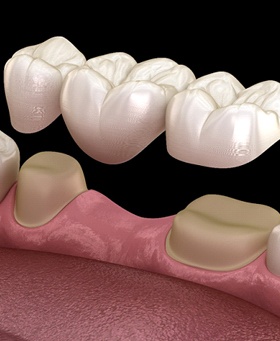
A bridge is created by taking one or more prosthetic porcelain teeth called “pontics” and suspending them between two dental crowns. These crowns fit over your existing teeth (or in certain cases, two dental implants) that serve as support. Bridges are designed to look as natural as possible in your mouth, and they can be used to perform the everyday functions of regular teeth – namely chewing, speaking, and biting. Note that in order for your teeth to hold a bridge, small amounts of enamel normally need to be removed so that there’s enough space for the crowns.
Advantages of a Dental Bridge

- Bridges are small and lightweight, so they’re comfortable to chew with.
- They’ll ensure that the force of your bite is correctly distributed in order to protect your other teeth.
- By filling in the empty space, you prevent other teeth from drifting.
- You’ll be able to speak and eat normally again.
- A bridge can last for many years with good oral hygiene.
Am I a Candidate for Dental Bridge?

A bridge can be used if:
- You are missing one tooth or a few teeth in a row AND
- The teeth on either side of the gap are still healthy and are strong enough to support crowns AND
- You have good oral health overall and are completely free from gum disease.
Dr. Lively can check your mouth to decide whether a dental bridge or another kind of restoration would be best in your case.
How Do I Care for a Fixed Bridge?
To take care of your bridge, brush and floss twice a day like you normally would. Thoroughly clean the area around and under the bridge; otherwise, the teeth supporting the crowns could start to decay, and that could cause the bridge to fail. It might help to add fluoride rinse to your oral hygiene routine. Also, don’t forget to return to 333 Dental Care so that Dr. Lively can clean your teeth and make sure that your bridge is still in good shape.
Implant-Retained Bridges
If you don’t want to make alterations to your natural teeth, you might be able to get a bridge instead. This has several advantages; in addition to leaving healthy dental structures in your mouth alone, implant placement helps stimulate the jaw so that it doesn’t suffer the deterioration that normally occurs whenever teeth are missing.
Dental Bridges FAQs
Can You Take a Dental Bridge Out?
Dental bridges are designed to replace lost teeth and remain fixed in their position within the smile unless they are removed by a qualified oral health professional like Dr. Lively. While you may have heard of “removable bridges,” this is a misnomer that refers to partial dentures that are designed to be removed by the patient for hygiene purposes. If you find that you are able to remove your dental bridge on your own, please contact our office in Magnum so we can schedule you for an appointment and determine if the device needs to be repaired or replaced.
How Long Should a Dental Bridge Last?
A dental bridge can usually last between five and fifteen years, but this can vary based on factors like the quality of care it receives, where it is placed in the mouth, and the material it is made from. Metal bridges may last slightly longer than metal-free bridges, but the difference is often negligible. Devices that replace teeth in the back of the mouth may not last as long as those placed in the front since they absorb more pressure during the chewing process. The most important factor in the longevity of your restoration is how well you maintain it by practicing proper oral hygiene, limiting your intake of sugars and acids, and avoiding bad habits like smoking, excessive alcohol consumption, grinding, using your teeth to open packages or bottles, and chewing on inedible materials like ice, metal, wood, plastic, and fingernails.
Can Dental Bridges Be Whitened?
Dental bridges are made from nonporous materials that do not respond to whitening treatments designed to brighten natural enamel, so receiving a whitening treatment while wearing a bridge can leave you with an unevenly colored smile. To prevent this, it’s usually best to have your teeth whitened before receiving or replacing your dental bridge so your appliance can be matched to the brighter shade of your new smile. You can prevent your bridge from developing stains by limiting your intake of discoloring foods and beverages like coffee, tea, red wine, cola, juice, berries, candy, and dark sauces and abstaining from bad habits like tobacco use and excessive alcohol consumption.
Can Dental Bridges Get Cavities?
Dental bridges cannot be affected by the destructive bacteria that cause cavities since they are not made from natural enamel, but the real teeth wearing the crowns supporting them can still be compromised by decay. This can happen due to food debris and sugary residue accumulating along the seam between the restoration and the natural tooth structure, which is usually due to poor oral hygiene. However, this can also happen if the cement holding an old bridge in place begins to erode, which can allow infectious material to build up in the space between the device and the tooth. To prevent this, practice excellent oral hygiene by brushing, flossing, and rinsing with antibacterial mouthwash every day while keeping up with biannual checkups at 333 Dental Care.